Lake Havasu City Is Landlocked, and the Northern Corridor Proves It
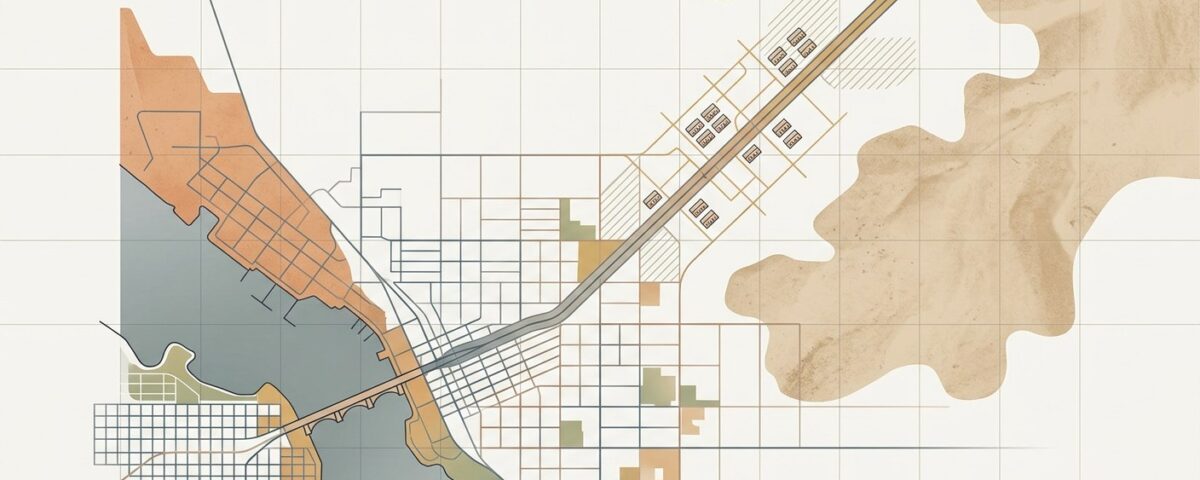
Commercial land in Lake Havasu City is not hidden. There just isn’t much left to find. The city is landlocked, and the northern corridor is largely state-controlled.
A 64-acre parcel north of the Shops at Lake Havasu was recently rezoned to General Manufacturing. That move confirms what the ground already shows. This market has one direction to grow, and it moves slowly.
Knowing the difference between a long-arc signal and a short-term repricing play is the entire game here.
Lake Havasu City’s commercial land supply is effectively exhausted within city limits, with meaningful growth constrained to a northern corridor dominated by state land. The recent General Manufacturing rezoning confirms the corridor’s direction but does not compress the state land release timeline investors often assume. Positioning ahead of this corridor requires patient underwriting of current income, not speculative land-value assumptions tied to a process measured in years, not quarters.
The Desert Hills Rezoning Points in One Direction
General Manufacturing zoning designations are rare inside Lake Havasu City limits. Most of the city falls into the C2 (light commercial) and light industrial categories. The M2 General Manufacturing inventory that does exist sits near the airport and now this northern parcel.
That distinction matters for a city built on tourism and service-sector employment. Higher-paying industrial jobs need appropriate zoning before they can arrive, and this rezoning begins to build that foundation.
The northern corridor is anchored by the Shops at Lake Havasu and extends outward from there. The 2008 downturn interrupted faster development, and the area has filled in gradually ever since. Flood plains, wash constraints, and timing kept it from reaching its potential for years.
The rezoning signals that the trajectory is continuing. Industrial tenants attract more industrial tenants; rooftops follow jobs, and that sequence is well documented in prior markets.
Privately held, deed-clear land in that direction is nearly gone. Move north past the existing commercial development, and you are looking at Arizona State Land Department territory. State land does not move fast.
State Land Is the Real Question, and It Moves Slowly
The state of Arizona largely controls the land surrounding that newly zoned parcel. Moving it into private hands requires an auction, entitlement review, and floodplain analysis. That review process does not compress to match a typical investor’s planning horizon.
A 600-acre state land section becoming an industrial subdivision is a plausible outcome in this corridor. Plausible, however, carries a timeline measured in years, not quarters.
That distinction changes the underwriting entirely. A thesis that depends on land releasing quickly and repricing immediately does not add up. Patient positioning is a different conversation entirely.
The rezoning functions as a long-arc catalyst. It confirms the corridor’s direction, signals the city’s and developer’s intent, and creates the anchor around which future state land releases will orbit. That is useful information. It is just not a 12-month trade.
Randy Shuffler has spent more than two decades underwriting commercial transactions in Lake Havasu City and the surrounding Mohave County region. His read on the northern corridor comes from direct transaction experience in this market, not secondhand commentary.
“Havasu is landlocked, and then you start going up that northern corridor, and there’s just not much deed land left, period. The state is going to have to let some of that property go, which is a long process. But all of a sudden, the state could release a 600-acre piece, and somebody could have some big plans, like, I’m going to turn this into a more industrial subdivision. I could totally see that actually happening.” – Randy Shuffler, Founder and Commercial Real Estate Agent, Lake Havasu City Commercial
Kingman Shows What Industrial Activation Looks Like
The land scarcity dynamic playing out in Havasu’s northern corridor is not unprecedented. Thirty miles east in Kingman, a working model of heavy industrial activation is already running.
Kingman sits at the intersection of I-40 and the future I-11 corridor. I-40 connects California to the eastern United States. I-11 will run from Mexico through Phoenix and Las Vegas into Canada. It also has rail running through it and proximity to a large airport.
The zoning is heavy industrial MX, and multiple companies have already placed 300,000-square-foot warehouse facilities there. Additional construction is underway toward a cumulative one million square feet. The tenant mix spans solar, gas, and block manufacturing, with more in the pipeline.
The inland port conversation, routing Long Beach container volume to an interior distribution hub, keeps landing on Kingman as a logical candidate. A formal inland port designation for Kingman has not been confirmed. The infrastructure, zoning, and tenant momentum, however, are real and compounding.
Kingman offers a preview for investors trying to read where Havasu’s northern corridor is heading. It shows what regional industrial activation looks like once zoning and land supply conditions align.
The Parcels That Actually Sit Inside the Opportunity
Not every parcel adjacent to the story sits inside it. Some parcels sit in the actual path of what is coming, and others just sit next to the narrative. That difference is worth understanding before you act on a headline.
Positioning ahead of this corridor means identifying parcels adjacent to the rezoned land that still trade at pre-announcement values. It also means underwriting on current income rather than speculative upside, and holding with patience.
The investors who benefit from rezoning catalysts are rarely the ones who buy the week the announcement drops. They’re the ones who understood the land release pipeline months earlier and knew that state land moves slowly. They positioned in surrounding private inventory before sellers priced in a timeline they do not control.
Access, zoning category, floodplain status, and frontage all matter here. Together, they determine whether a property sits in the path of development or just beside it.
Ground-level analysis of the specific parcel is required before drawing that conclusion. The Federal Emergency Management Agency’s flood map service is a useful starting point for checking floodplain constraints. Local knowledge of how those overlays interact with specific parcels is irreplaceable.
Underwriting a Long-Arc Corridor Play
The underwriting discipline for a corridor position differs from a stabilized income buy. You are not acquiring a cash machine on day one. You are acquiring a constrained asset in a physically limited market. The secondary thesis is that supply cannot respond to demand, and the corridor has only one direction to travel.
That secondary thesis needs to stay secondary. Deals that pencil on current true-net income, with corridor upside as a bonus rather than a requirement, are the ones worth pursuing. Some deals only pencil if state land releases on a compressed schedule and tenants arrive ahead of infrastructure. Those are worth passing on, regardless of how compelling the headline sounds.
Answers to Common Questions
Is Lake Havasu City actually running out of commercial land for sale?
Within city limits, usable commercial inventory is effectively exhausted. Most remaining undeveloped land in the northern corridor is state-controlled. That places it outside normal private transaction channels until auction and entitlement processes run their course. Deed-clear, privately held commercial parcels are scarce, and that scarcity directly supports existing property values.
How long does Arizona state land typically take to reach the private market?
The Arizona State Land Department process involves auction, entitlement review, floodplain analysis, and regulatory approvals that routinely span multiple years. Investors who underwrite positions based on near-term state land releases are building on an assumption the process does not support. Patient positioning, underwritten on current income, is the more defensible approach.
What does General Manufacturing zoning allow in Lake Havasu City?
General Manufacturing, or M2 zoning, permits heavier industrial uses than light industrial categories allow. That includes distribution warehousing, manufacturing operations, and large-scale equipment storage. It is rare inside Lake Havasu City limits. That is why the rezoning carries directional weight for investors watching where higher-employment uses can legally locate.
Why does the Kingman corridor matter to Lake Havasu City commercial investors?
Kingman represents a working example of regional heavy industrial activation. Kingman already has I-40 access, rail, an established airport, and heavy industrial MX zoning. It shows what the next phase of corridor development looks like once land supply and zoning conditions align. It serves as a directional indicator of where Havasu’s northern corridor is headed over a multi-year arc.
What is an inland port, and why does it keep coming up in corridor discussions?
An inland port routes container freight from coastal ports, such as Long Beach, to an interior distribution hub. Goods are then sorted and redistributed by rail or truck. Kingman has emerged as a logical candidate given its rail access, I-40 convergence, and existing heavy industrial zoning. No formal designation has been confirmed, but the existing infrastructure would support one.
Should I underwrite northern corridor commercial land on current income or future upside?
Current income is the defensible anchor for any underwriting in this market. Speculative upside tied to state land releases or future tenants is a secondary thesis with no reliable timeline. Deals that only work under optimistic assumptions tend to break at the worst possible moment.
How do floodplain constraints affect northern corridor development potential?
Floodplains and wash constraints have slowed northern corridor development for years. Parcels that overlay active wash corridors or mapped flood zones carry entitlement complexity that adds both cost and time to any development program. Confirming a parcel’s floodplain status before underwriting is a required first step, not an afterthought.
Verify the Parcel Before You Act on the Headline
Rezoning news moves fast. State land timelines do not. The investors who position correctly in a corridor like this verify the parcel-level specifics before they underwrite the speculative case.
The northern corridor confirms a direction. It does not compress a timeline.
Are you evaluating a specific parcel in or near this corridor? Send me the address and request a true-net snapshot. I’ll tell you exactly what the current income supports and what the land release timeline means for your underwriting. That is the starting point, not the headline.
Randy Shuffler is the founder of Lake Havasu City Commercial and a commercial real estate agent at Realty ONE Group Mountain Desert. He holds the CCIM designation and a BS in Finance from San Diego State University. For more than two decades, he has focused exclusively on commercial investment properties in Lake Havasu City, Kingman, and the greater Mohave County area.
ABOUT THE AUTHOR
Randy Shuffler | Founder & Commercial Real Estate Agent, Lake Havasu City Commercial | CCIM | 20+ years in real estate & finance | $5M+ in verified sales | 52,000+ sq ft transacted | BS Finance, San Diego State University | Realty ONE Group Mountain Desert