Lake Havasu City Land Scarcity Is Permanent and Investors Need to Underwrite It
Good commercial deals in Phoenix and Scottsdale do not wait. In the sub-$3 million range, the properties that actually pencil go under contract in a day. And the best ones never hit a listing platform at all.
Good commercial properties under $3 million in Phoenix and Scottsdale sell within a day of hitting the market, making off-market relationships with brokers essential for 1031 exchange success. Investors must pre-underwrite their replacement criteria and actively contact building owners before the 45-day identification window opens, since waiting for public listings means competing with every other buyer for already-seen opportunities. If the right deal doesn’t exist within the timeline, paying taxes on the sale is preferable to forcing a purchase that doesn’t pencil financially.
If you are running a 1031 clock and counting on a listing to surface in time, that is a problem worth understanding.
The Inventory Problem Is Thinner Than You Think
Most investors coming from out of state assume that a slower national market means more options. In Arizona right now, that is not what I am seeing.
I recently worked with a client who sold a building in Lake Havasu City for $1.85 million. They needed to place that capital into a replacement property in the $1.8-$2.5 million range. They were looking at Flagstaff or Scottsdale. Reasonable budget, reasonable markets.
They found three or four properties worth looking at. That is the current reality for quality income property under $3 million in Arizona.
It is not that nothing exists. The good stuff gets absorbed fast. What lingers on the market tends to linger for a reason. The price may be too high, or the cap rate might be too low. There could be something wrong buried in the lease.
Priced right with solid tenants, a property sells. Everything else sits and waits for someone to rationalize it.
Waiting for Listings Is a Losing Strategy in Arizona
When a property like the Pep Boys in Scottsdale hits the market, it goes in a day. It had a 6.8 cap rate, a triple net five-year lease with options, and a good location. The buyers who win in this environment are not refreshing listing platforms.
You have to pre-underwrite your criteria before the search starts and maintain working relationships with brokers who hold active buyer lists. Success means being ready to move when something appears. The buyers who scramble are the ones who start their search after the 45-day identification window opens.
Off-market search means writing letters to building owners in target corridors. You need to work with agents in Phoenix and Scottsdale and identify properties that might trade before they ever hit the market. It is time-intensive work.
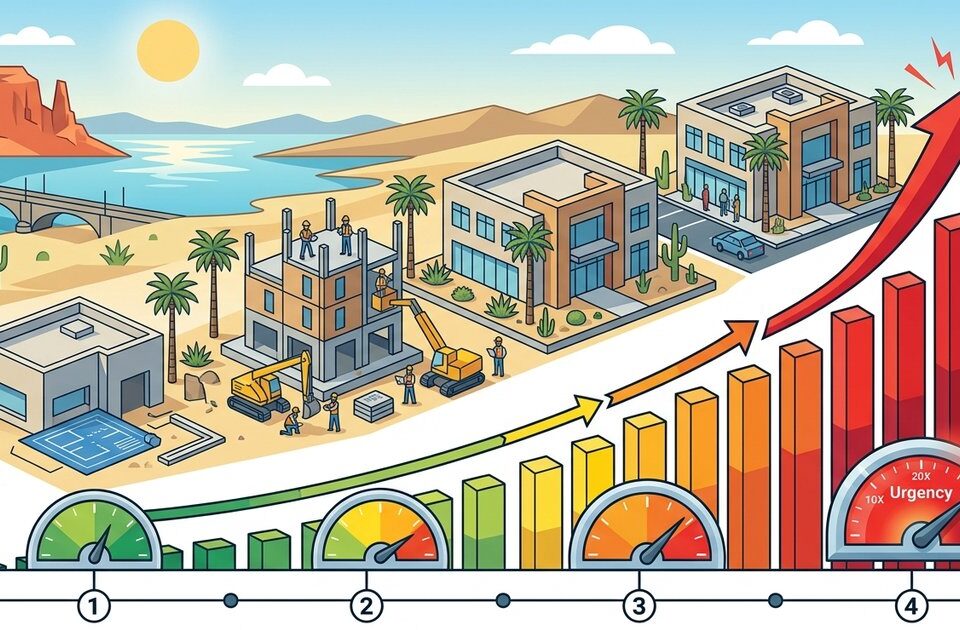
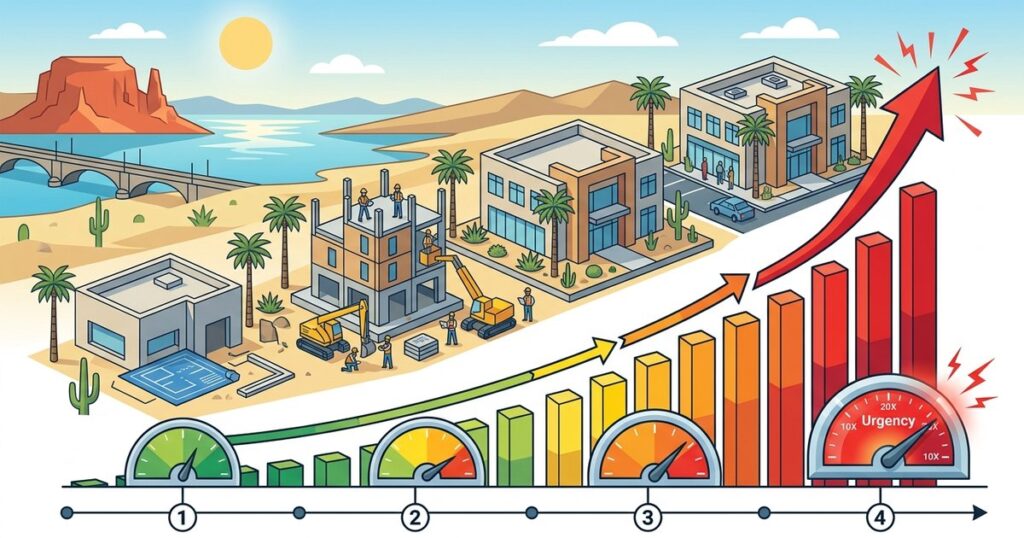
The Internal Revenue Service’s 1031 exchange rules are unambiguous on timing: 45 days to identify, 180 days to close. There is no flexibility built into those deadlines for a thin inventory environment.
What’s Happening on the Ground Now
I went into the Phoenix metro recently, looking at Scottsdale properties priced between $1 million and $3 million. The expectation was a real list of options.
“We went down to Phoenix, properties in Scottsdale from a million to three million. When a good property comes up, and it’s got good tenants, it sells. Like that Pep Boys: 6.8 cap at 2.2 million, triple net, five-year lease with two-year options, great part of Scottsdale. They sold it in a day.” – Randy Shuffler, Founder and Principal Broker, Lake Havasu City Commercial at Realty ONE Group Mountain Desert
The Tax Math Is What Makes the Clock Feel So Heavy
Here is why investors push so hard to complete these exchanges even when the market is tough.
Take a building bought for $1 million, sold for $1.85 million, with accumulated depreciation built up over the holding period. The tax hit on that sale, federal capital gains plus depreciation recapture and state taxes, can run past $200,000. That is real money walking out the door.
Put that same $200,000 to work in a replacement property at a 6.5-7% cap instead. Over ten years, the difference between paying the tax and deferring it is significant.
But here is the other side of that. I am direct with my clients about this.
If the right deal does not exist, pay the taxes. Buying a bad building just to beat the clock is one of the worst moves I see investors make. The exchange serves your investment thesis. It does not obligate you to a deal that does not pencil. Forcing a purchase under deadline pressure is how disciplined investors end up owning problems.
What Off-Market Search for Phoenix Commercial Property Looks Like
When I go active for a 1031 client in a market like Phoenix or Scottsdale, public listings are the starting point, not the strategy.
Real off-market search means targeted mailers to building owners in specific corridors. It means calling commercial agents who sit on active buyer and seller lists. It means conversations with owners who have not decided to sell yet but might respond to the right number at the right time.
Three to five hundred letters into a target area might produce five or six real conversations. Some turn into listings and others close off-market. The hit rate is low. But what surfaces is usually different from what you find on LoopNet. By the time something lands on a public platform, every active buyer in that market has already seen it.
The investors who get the best deals in tight markets are not the most patient ones. They are the ones already in conversation when the property becomes available.
For investors also looking at Lake Havasu City commercial property as part of a broader Arizona search, the same logic applies. The scarcity runs across the corridor.
I hold the CCIM designation, administered by the CCIM Institute. That training is built around underwriting from true net income and cash flow, not surface-level cap rates or gross revenue projections. In a tight market with thin inventory, that distinction is what keeps you from overpaying for something that looks better than it is.
FAQs About Commercial Deals in Arizona
Are the good deals really gone in a day?
Yes. Stabilized triple net properties in the $1 to $3 million range with real tenants and a cap rate that makes sense go fast. Sometimes the same day. Waiting for a listing alert means you are competing with every other buyer who got the same notification at the same time.
What cap rates are realistic for Scottsdale commercial property right now?
Quality triple-net deals with solid tenants are trading in the 6.3-6.8 range. If you are expecting 7-plus caps on good assets in Scottsdale, the inventory will not meet that expectation.
How do I find a 1031 replacement property when the 45-day window is open?
Pre-underwrite your replacement criteria before the identification window opens. Define your cap rate floor, asset class, geography, and true net income target in advance. From there, direct broker outreach into your target corridor gives you access to deals that never reach public platforms. Starting the process after the window opens is the primary reason 1031 buyers settle for inferior properties.
What happens if I cannot find the right deal before the 45-day identification window closes?
Pay the taxes and wait. A $200,000 tax bill is painful. Owning a building that lacks cash flow because you bought it under time pressure is worse. The exchange does not obligate you to a bad investment.
What does off-market commercial search in Arizona actually involve?
Direct mail to building owners in target corridors, calls to agents with active buyer and seller lists, and conversations with owners who have not listed but might sell. Three to five hundred letters might produce five or six real conversations. Low conversion rate, but you surface deals that the broader market hasn’t seen yet.
How does accumulated depreciation affect my decision to do a 1031 exchange?
Accumulated depreciation on a sold property gets recaptured at tax time under IRS Section 1250. That increases the total tax liability beyond the capital gain alone. That changes the urgency calculus for completing an exchange and compounding the deferred capital forward at a 6.5-7 cap.
Should I hire a local broker for my Phoenix and Scottsdale replacement search?
Yes. A broker without active relationships in those corridors can only show you what is already public. By the time it is on LoopNet, the fast buyers have already seen it. You need someone who can access the deal before it becomes visible.
Start the Search Before the Clock Starts
A tight market rewards readiness and direct access. The best properties move through networks, not public platforms. That reality shapes how successful investors operate.
Shuffler Commercial Realty helps investors position themselves before opportunities surface. We work directly with owners and brokers across Phoenix and Scottsdale. Contact our team to get ahead of your next acquisition.
Randy Shuffler is the founder of Lake Havasu City Commercial at Realty ONE Group Mountain Desert. He holds the CCIM designation, placing him in the top 6% of commercial practitioners nationally, and brings over 20 years of Arizona commercial real estate experience to every search he runs.
ABOUT THE EXPERT
Randy Shuffler | Founder & Principal Broker, Lake Havasu City Commercial | CCIM | 20+ years in real estate & finance | $5M+ in verified sales | 52,000+ sq ft transacted | BS Finance, San Diego State University | Realty ONE Group Mountain Desert