Lake Havasu Commercial Rents Depend on Which Corridor You Are In
Lake Havasu City commercial rents vary significantly depending on a range of factors. One of the most significant factors is which corridor the property is in.
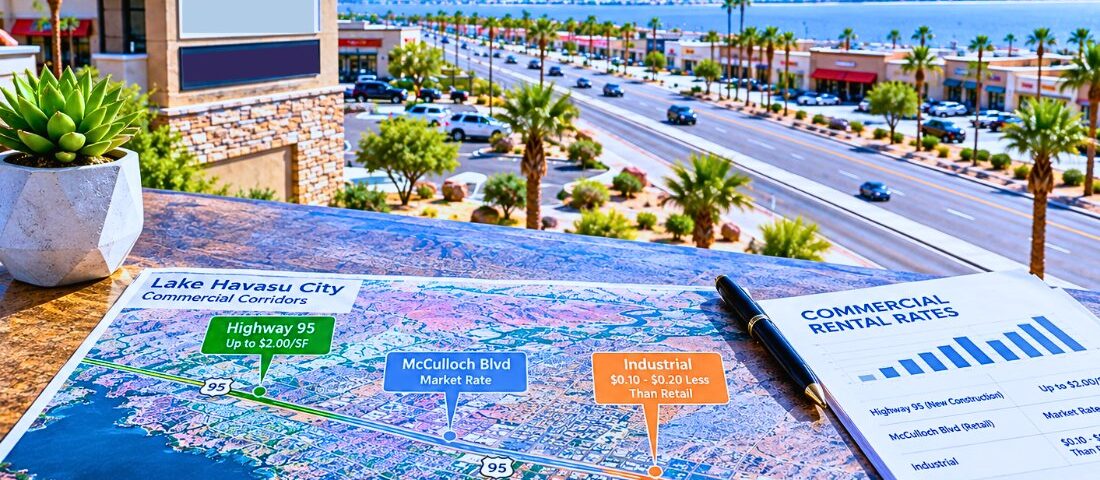
Highway 95 new construction with anchor visibility has reached $2.00 per square foot. McCulloch Boulevard retail leases at market rate, but won't find tenants when priced too high. Industrial space has closed most of its historical gap with retail as bay-door demand absorbed available supply.
Using the market average for rents is where underwriting starts to come apart for out-of-state investors. Accounting for the corridor where the property sits gets you to reliable numbers.
Commercial rents in Lake Havasu City vary sharply by corridor, not just by asset class. Highway 95 new construction with anchor tenants commands up to $2.00 per square foot, and McCulloch Boulevard retail requires disciplined pricing to lease. Industrial rates have narrowed to within 10 to 20 cents of comparable retail as demand absorbed available supply. Investors who underwrite to a market-wide average will build a model that does not survive contact with reality.
The Rent Reality on McCulloch Boulevard
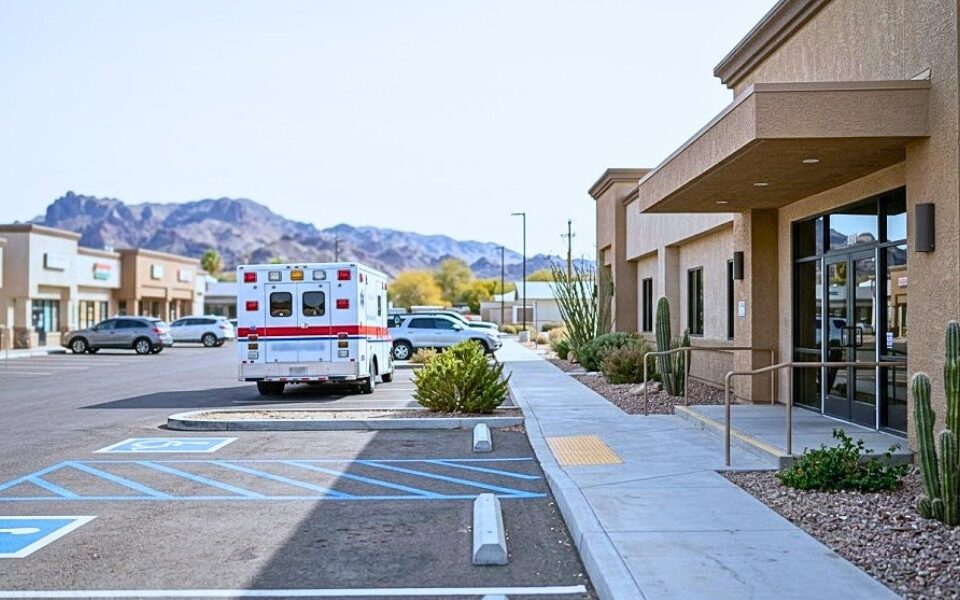
McCulloch Boulevard earns the landlord's market label for real reasons. Restaurant clusters, medical tenants, and grocery-anchored centers draw consistent foot traffic and support genuine leasing velocity.
While that velocity is real, it does have a ceiling. One 4,000-square-foot storefront in a great location on McCulloch sits empty right now. The former furniture tenant is gone, but the foot traffic is still there.
Why is a solid location on McCulloch Boulevard sitting empty? The landlord priced the space as if demand alone would close the gap between market rate and his target number. That pricing strategy is not working out.
The landlords on McCulloch Boulevard have real pricing power. However, pushing that leverage too far will result in long vacancies.
For a broader orientation on retail corridors across the city, the Lake Havasu commercial property overview covers the major pockets. It offers a useful starting point before you start running specific numbers.
The Retail Picture on Highway 95
Follow Highway 95 through town, and you find the market's upper tier. New construction with strong visibility off the highway has achieved rents up to $2.00 per square foot, but that number does not arrive automatically. It requires the right combination of visibility, build quality, and anchor presence.
One retail center along Highway 95 attracted Dunkin' Donuts as an anchor and filled its remaining bays at those rates. The formula was straightforward: new building, clear highway visibility, a national credit tenant generating consistent traffic. That combination unlocked pricing that McCulloch Boulevard does not reliably reach.
Location within the Havasu market is the primary underwriting variable. Downtown and the Highway 95 corridor attract different tenant profiles and support different rent structures. An investor underwriting both corridors as interchangeable will build a model that does not survive first contact with a real lease negotiation.
Why Did Industrial Rents Close the Gap With Retail?
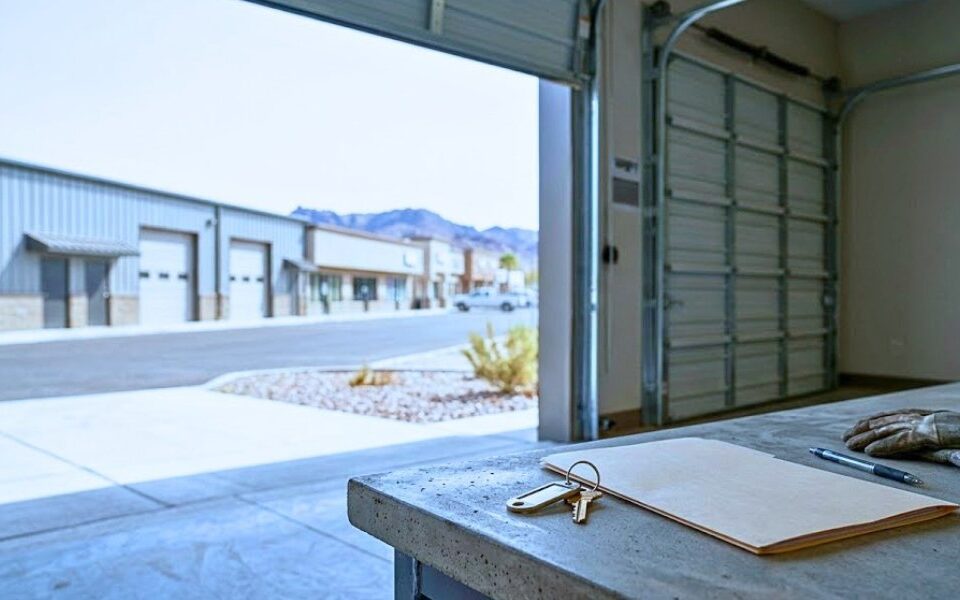
In recent history, Lake Havasu City commercial rents by corridor showed a predictable spread: roughly $0.70 per square foot for industrial versus $1.00 for retail. That gap has compressed, and the compression reflects real tenant demand.
Demand for bay-door space absorbed available supply across the market. Local service businesses, contractors, detail shops, and light industrial operators need functional space with vehicle access. They cannot find enough of it, particularly in smaller size ranges. The 2,000-to-5,000-square-foot bay space category faces the tightest supply constraints in the current market. Larger vacancies in the 9,000-square-foot range take longer to fill but attract more established tenants when they do move.
The spread today between a well-located industrial unit and comparable retail sits at roughly 10 to 20 cents per square foot, depending on the property. In some cases it narrows further.
Randy Shuffler has spent more than two decades transacting across both asset classes in the Havasu and Kingman markets. He has worked both sides of the leasing equation on retail and industrial deals.
"Industrial used to be, back in the day, industrial is 70 cents and retail's a dollar. And then there was so much demand for industrial that it's kind of caught up some. But for nice retail stuff, yeah, you're still looking somewhere in there 10 to 20 cents more, give or take." – Randy Shuffler, Founder and Commercial Real Estate Agent, Lake Havasu City Commercial at Realty ONE Group Mountain Desert
For a closer look at what drives that industrial demand, read my piece on why Lake Havasu light industrial space stays tight. It runs through the supply mechanics in detail.
What Out-of-State Investors Get Wrong About Havasu Rents
The third-party headline is that Lake Havasu is a landlord's market with strong activity on McCulloch. That is not entirely wrong, but it is an incomplete view of the market.
New construction with Highway 95 visibility can support $2.00 per square foot, and well-located McCulloch retail, priced correctly, leases. Industrial space with bay doors in the right size range generates rates that have closed most of the historical gap with retail. Off-corridor retail carrying an inflated ask sits, sometimes for a long time.
Before backing into value on a Havasu deal, three questions determine whether your model reflects the real market:
- Which corridor does the property actually occupy?
- What does comparable new construction command on that specific corridor?
- Do the current asking rents reflect recent transactions or a landlord's target number?
Get those answers before any offer goes in. The corridor analysis that feels like extra work up front is the same analysis that protects the downside if the deal goes sideways.
Investors working a 1031 timeline face additional pressure here. Pre-positioning before your California closing starts gives you time to run that corridor analysis without the 45-day clock forcing a decision. Read my piece on 1031 exchange pre-positioning to learn more about this process.
Factors Driving Premium in The Highway 95 Corridor
Highway 95 premium rents depend on three factors working together. You need new construction quality, clear highway visibility, and an anchor tenant that generates consistent traffic. Remove any one of those and the $2.00 per square foot ceiling becomes a ceiling the property does not reach.
Older product on the same highway with less visible positioning does not automatically command those rates. The corridor address creates the opportunity. The building and the tenant mix determine whether that opportunity converts to actual rent. That distinction matters for investors evaluating both new construction opportunities and existing stabilized assets on the same corridor.
The U.S. Census Bureau's County Business Patterns data confirms retail trade concentration along major highway corridors in smaller Arizona markets. This supports the traffic and tenant-profile logic that underlies Highway 95 pricing in Havasu.
FAQs About Lake Havasu City Commercial Rents by Corridor
What are current retail rents in Lake Havasu City in 2026?
Retail rents in Lake Havasu City range from roughly $1.20 to $2.00 per square foot depending on corridor and build quality. Highway 95 new construction with anchor tenants and strong visibility sits at the top of that range. McCulloch Boulevard downtown retail leases at lower rates when priced correctly. Overpriced space, even in the best corridor, will sit vacant. Underwrite to corridor-specific comparables, not a market-wide average.
Is McCulloch Boulevard still the strongest retail corridor in Lake Havasu City?
McCulloch Boulevard draws consistent foot traffic from restaurant, medical, and grocery-anchored tenants. That makes it the most recognizable retail corridor in Lake Havasu City. However, that does not mean landlords can get away with overpricing. Landlords who push above market rates find spaces sitting vacant for months.
How do industrial rents in Lake Havasu City compare to retail rents right now?
Industrial rents have closed most of their historical gap with retail. The old spread ran about 30 cents per square foot in retail's favor. Today that gap sits at roughly 10 to 20 cents, with some properties narrowing it further. Sustained demand for bay-door space in the 2,000-to-5,000-square-foot range drove most of that compression.
What size range is most constrained in the Lake Havasu industrial market?
The 2,000-to-5,000-square-foot bay space category faces the tightest supply constraints. Service businesses, contractors, and light industrial operators consistently compete for this size range because it matches their operational footprint. Adequate supply does not yet exist to meet that demand. Larger spaces in the 9,000-square-foot range take longer to fill. When they do come available, they tend to attract more established tenants.
How should an out-of-state investor underwrite Lake Havasu commercial rents by corridor?
Identify the corridor a property occupies before building any rent assumption. Highway 95, McCulloch Boulevard, and off-corridor locations each support different tenant profiles and rent structures. Run comparable new construction rates on the same corridor rather than relying on market-wide averages. That produces a defensible underwriting model. My post on what California investors get wrong about Havasu cap rates extends this framework into cap rate analysis.
Does the landlord's market label apply to all Lake Havasu commercial inventory?
No. The landlord's market characterization applies to well-located assets on active corridors. Off-corridor retail and overpriced space on stronger corridors both produce meaningful vacancy. The label describes a tendency in specific pockets of the market, not a guarantee across all inventory. Pricing discipline is required to capture the advantage the corridor creates.
What commercial zoning governs retail and industrial uses in Lake Havasu City?
Lake Havasu City uses a commercial zoning framework administered by the Lake Havasu City Planning Department. Retail corridors like McCulloch Boulevard typically operate under C-2 General Commercial zoning. Industrial uses generally require M-1 Light Industrial or M-2 General Manufacturing designation. Zoning classification affects permitted use and development standards, influencing the tenant pool a property can attract and the rent structure it can support. Confirm zoning with the city before any offer goes hard.
Which tenant types anchor the strongest Lake Havasu retail centers?
National quick-service restaurant brands, medical tenants, and grocery operators anchor the strongest performing retail centers in Lake Havasu City. These tenants generate consistent foot traffic that supports surrounding bay tenants and justifies higher rents on the same project. Off-corridor centers without anchor traffic rarely achieve the same leasing velocity regardless of asking price.
Run the Corridor Analysis Before You Write the Offer
Corridor analysis matters significantly when underwriting properties in Lake Havasu. Knowing that Havasu trends toward a landlord's market tells you the direction, but the corridor your target property occupies tells you much more.
Do you want a true-net snapshot on a specific property? Send the address to Lake Havasu City Commercial. We'll run the numbers before you commit.